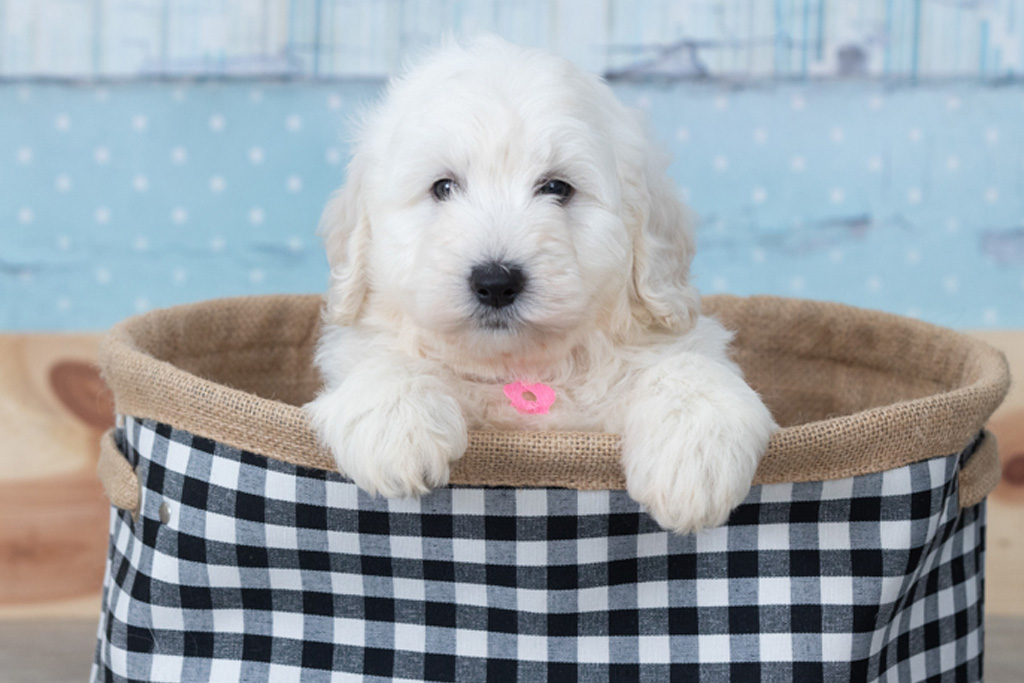
One of the first things people notice about a Minidoodle is the coat.
It may be soft and loosely wavy, fuller and denser, or noticeably curlier. Some coats seem to brush out easily, while others can develop tangles surprisingly quickly. Even within the same litter, puppies can grow into coats that look and behave a little differently from one another.
That variation is important because grooming should not be based on appearance alone.
Your Minidoodle’s coat is constantly giving you clues about what it needs. How quickly it tangles, how easily a comb moves through it, whether it traps debris after outdoor play, and how much work it takes to keep it comfortable all help tell you whether your current routine is working.
The goal is not to assign your dog to a perfect coat category and follow a rigid set of rules from there. Royal Minidoodles are a cross between English Cream Golden Retrievers and Miniature Poodles, so coat characteristics can vary. The more useful approach is to learn how your individual dog’s coat behaves and to adjust grooming based on what you actually see and feel.
Once you start paying attention to those clues, grooming becomes much less mysterious.
Wavy, Curly, and Everything in Between
Minidoodle coats do not all grow in exactly the same way.
Some dogs have a softer, looser wave that falls relatively freely. Others develop more curl, while some have a denser coat that can feel fluffy and substantial even when the individual hairs are not tightly curled.
Those differences affect maintenance.
Curly and longer coats tend to be more prone to tangling because loose hairs can become caught in the surrounding coat rather than simply falling away. Veterinary grooming guidance notes that long, silky, and curly coats typically require more frequent brushing to prevent tangles and mats.
A looser coat may sometimes feel easier to manage, but that does not mean it should be ignored. Length, density, activity level, and the individual dog all influence how quickly problems develop.
Rather than asking whether your Minidoodle has a “good” or “difficult” coat, ask a more practical question: how much maintenance does this particular coat require to stay comfortable?
If the Coat Tangles Quickly, It Is Asking for More Frequent Care
One of the clearest signals is how quickly tangles return after brushing.
If you thoroughly brush and comb your Minidoodle one evening and find knots developing again within a day or two, the coat probably needs more frequent attention.
This is especially common with longer, curlier, or denser coats.
The answer may be more frequent brushing, but it can also mean that your current haircut is longer than your household can realistically maintain.
There is nothing wrong with adjusting the style.
A shorter trim can make a dramatic difference in the amount of time needed at home, particularly for active dogs or families who would rather spend their evenings playing with their Minidoodle than working through a full coat.
The right grooming routine should fit real life.
If the Top Looks Fluffy but the Comb Gets Stuck, Look Deeper
This is probably one of the most important things Minidoodle owners can learn.
A coat can look beautiful on the surface while tangles are forming underneath.
Brushing only the outer layer can fluff the hair without reaching the skin, where hidden knots often develop. Grooming professionals commonly recommend working through the full depth of the coat rather than simply smoothing the top.
A metal comb can be a useful reality check after brushing.
If the comb moves smoothly from near the skin to the ends of the coat, you are probably reaching the areas you need to. If it catches repeatedly or cannot move through certain sections, there may be tangling beneath the surface.
This is one of those cases where your Minidoodle’s coat is sending a clear message: the brushing routine needs to go a little deeper.
Pay Special Attention to High-Friction Areas
Certain parts of the coat deserve extra attention because they rub against other surfaces throughout the day.
Behind the ears, beneath collars and harnesses, under the front legs, and along the areas where the legs meet the body, tangles can form more quickly than along the coat on the back. The ears, armpits, and backs of the legs are common places where longer or curly coats can mat.
These spots may need a quick check even when the rest of your Minidoodle looks perfectly fine.
The good news is that catching a small knot early is usually far easier than discovering a larger mat several weeks later.
A few minutes of targeted grooming can save a great deal of work.
Your Minidoodle’s Lifestyle Shows Up in the Coat
The coat tells you something about your dog’s lifestyle too.
A Minidoodle who spends weekends hiking, playing in tall grass, swimming, or exploring muddy trails will usually bring more of the outside world home in their hair than a dog whose favorite adventure is a leisurely neighborhood walk.
Leaves, burrs, moisture, dirt, and other debris can become caught in longer coats and cause tangling if not removed.
That does not mean active Minidoodles need to avoid outdoor fun. Quite the opposite.
It simply means the grooming routine should match the life you want for your dog.
For active households, a somewhat shorter trim may make cleanup easier and allow you to check the coat and skin more efficiently after adventures. Families who prefer a longer style may simply need to plan for more frequent brushing after outdoor activity.
The coat does not dictate the lifestyle. It helps you choose a maintenance plan that supports it.
Notice How the Coat Behaves After Getting Wet
Water can tell you a lot.
If your Minidoodle loves swimming, plays in the rain, or regularly gets wet during outdoor activities, pay attention to how quickly and thoroughly the coat dries.
Dense or longer coats can hold moisture closer to the skin, especially if tangles are already present. Mats can reduce airflow and trap moisture, which may contribute to skin irritation.
After swimming or bathing, towel-dry your dog thoroughly and check the areas where the coat is thickest.
A wet coat that repeatedly takes a very long time to dry may be another reason to consider a more manageable length, particularly during seasons when your dog is in and out of the water frequently.
Comfort matters more than maintaining a specific look.
Puppy Coats Can Be Deceptively Easy
One reason grooming can surprise new owners is that the puppy coat may be easier to manage than the adult coat that follows.
Young Minidoodles often begin with especially soft hair that can feel relatively simple to brush. As the coat matures, texture, density, and curl may change, and the grooming routine that worked perfectly for the puppy may suddenly be insufficient.
This transition is normal.
Rather than waiting for the first difficult grooming appointment to discover the difference, pay attention as your puppy grows. If areas begin tangling more quickly, brushing takes longer, or the coat feels noticeably different to the touch, it may be time to update the routine.
Your groomer can also help you identify when that transition is happening and what changes will make maintenance easier.
Do Not Assume the Adult Coat Will Look Exactly Like the Puppy Coat
Minidoodle puppies are still developing, so the coat you see during the earliest months is not always a perfect preview of the adult coat.
Texture can become curlier, denser, or simply more substantial as your dog matures. The amount of maintenance may increase even when the overall look does not change dramatically.
That is why it is often more useful to watch behavior rather than appearance.
If your dog is suddenly developing tangles more quickly or brushing has become more difficult, the coat is telling you that something has changed, even if you cannot immediately see why.
The routine should evolve along with the dog.
Shedding Expectations Should Stay Realistic
The word “doodle” often comes with strong assumptions about shedding.
Because Minidoodles have Poodle heritage, some may shed less than a typical English Cream Golden Retriever, but mixed-breed coats can vary, and appearance alone does not guarantee that a dog will be completely non-shedding. Doodle mixes can inherit a range of coat characteristics, with curlier coats often shedding less visibly but requiring more grooming because loose hair tends to get caught in the coat.
That tradeoff is worth understanding.
Less hair on the furniture does not necessarily mean less coat maintenance.
In fact, a dog whose loose hair stays trapped within the coat may need very consistent brushing to remove it before tangles form.
The goal should not be chasing a perfect “non-shedding” label. It should be learning what your Minidoodle’s actual coat requires.
If the Coat Keeps Matting Before Appointments, the Schedule May Need to Change
Sometimes the issue is not your brushing technique.
The interval between professional appointments may simply be too long for the coat and style you are maintaining.
If your Minidoodle regularly develops tangles during the final week or two before grooming, that pattern is useful information. You may need more frequent professional maintenance or a shorter haircut.
This is where the grooming schedule and coat-type conversations naturally meet.
Once you understand how your dog’s coat behaves, our guide to How Often Should a Minidoodle Really Be Professionally Groomed? can help you think through appointment timing based on age, coat length, lifestyle, and home maintenance.
The two decisions work together.
Your coat tells you what it needs, and your schedule helps you stay ahead of it.
If the Coat Is Easy to Comb, Your Routine Is Probably Working
Not every clue points toward more work.
Sometimes the best sign is that nothing dramatic is happening.
If your Minidoodle’s coat remains easy to brush, a comb moves through comfortably, the skin looks healthy, and you are not constantly fighting tangles before the next grooming appointment, your current routine may be a good fit.
There is no need to add complexity simply because another Minidoodle owner follows a different schedule.
Different dogs can require different levels of maintenance. Groom your dog often enough that your dog remains comfortable and the coat remains manageable.
The Coat Can Help You Choose a Better Haircut
Haircut decisions often begin with a photograph.
Families see a Minidoodle with a beautiful fluffy coat and want the same look, which is completely understandable.
The better question is whether that length works with your dog’s actual coat and your family’s routine.
A curlier or denser coat may require much more brushing to maintain at a longer length. An active dog may constantly collect debris. A dog who swims frequently may be easier to dry with a shorter trim.
None of those things make one haircut better than another.
They simply help you choose a style you can realistically maintain.
A good groomer can help translate the look you like into a version that works for the Minidoodle standing in front of them.
Seasonal Changes May Affect What the Coat Needs
Your Minidoodle’s coat may need different attention at different times of year.
Summer can mean more swimming, outdoor activity, dirt, and plant debris. Winter may bring wet snow, jackets, sweaters, and harnesses that increase friction on longer hair.
Seasonal weather can also change how frequently you bathe, dry, or brush your dog.
Rather than assuming summer always requires one haircut and winter another, look at what is actually happening to the coat.
If your Minidoodle spends half the summer in the lake, drying more easily may become a priority. If winter sweaters create constant tangles beneath the chest and legs, those areas may need more frequent attention or a different trim.
Again, the coat will usually tell you where the problem is.
Changes in the Coat Can Occasionally Mean More Than Grooming
Most grooming changes are completely ordinary, especially as puppies mature or seasonal routines change.
However, a noticeable change in coat quality can occasionally reflect something happening beyond the grooming routine.
Veterinary guidance notes that nutrition and overall health can affect coat texture and appearance.
If your Minidoodle develops sudden hair loss, persistent skin irritation, significant itching, unusual odor, or a major change in coat condition, do not assume another grooming appointment will solve it.
That is a conversation for your veterinarian.
Your groomer can be an excellent extra set of eyes, but skin and health concerns belong with the medical professionals who can determine what is actually happening.
Your Groomer Can Help You Learn Your Dog’s Coat
One of the best things a new Minidoodle owner can do is ask questions during grooming appointments.
Ask where your dog tends to tangle.
Ask whether you are brushing thoroughly enough.
Ask which tools work best for the coat and whether your preferred haircut is realistic for the amount of maintenance you want to do.
A good groomer sees the coat after several weeks of life at home, which gives them useful information about what is working between appointments.
They can often tell you immediately whether the coat needs more frequent brushing, whether a particular area is being missed, or whether a slightly shorter style would make everyone’s life easier.
Grooming does not have to be guesswork.
Learn the Coat You Have, Not the Coat You Expected
It is easy to have expectations about what your Minidoodle’s coat will look like before the puppy grows up.
The reality may be slightly different, and that is part of having a mixed-breed dog.
Your Minidoodle may grow into loose waves, a curlier coat, a fuller texture, or something comfortably in between. What matters most is not fitting that coat into a perfect label.
What matters is understanding it.
Notice where it tangles. Pay attention to how quickly it grows. Learn what happens after swimming, whether a harness creates knots, and how often your comb begins catching beneath the surface.
Those little observations tell you much more than a coat-category chart ever could.
Once you understand how the coat behaves, grooming becomes less about following generic rules and more about caring for your individual dog.
And that is ultimately the goal: a Minidoodle who looks beautiful, feels comfortable, and has a grooming routine that fits naturally into the life you share together.
Frequently Asked Questions
What coat types can Minidoodles have?
Minidoodles can have varying degrees of wave, curl, density, and softness because they have English Cream Golden Retriever and Miniature Poodle parentage. Individual coats can differ, even among puppies from the same litter.
Does a curlier Minidoodle coat need more grooming?
Often, yes. Curly and longer coats tend to be more prone to tangling and matting and may require more frequent brushing and professional grooming.
How can I tell if I am brushing my Minidoodle thoroughly enough?
After brushing, gently run an appropriate metal comb through the coat toward the skin. If the comb repeatedly catches, there may still be tangles beneath the fluffy outer layer.
Where do Minidoodles mat most easily?
Areas with frequent friction commonly need extra attention, including behind the ears, beneath collars and harnesses, under the legs, and around other areas where the coat rubs against itself.
Does a Minidoodle’s coat change as they grow?
Yes. The soft puppy coat transitions as dogs mature, and the adult coat may differ in texture, curl, density, and maintenance needs. Grooming routines often need to change along with it.
Are Minidoodles completely non-shedding?
Not necessarily. Shedding can vary because Minidoodles inherit coat characteristics from both parent breeds. Curlier doodle coats may retain more loose hair, which can mean less visible shedding but a greater need for brushing.
Should I keep my Minidoodle’s coat short if it mats easily?
A shorter trim can make maintenance easier, especially for dogs with coats that tangle quickly or for active households. Work with your groomer to find a length that keeps your dog comfortable while matching the amount of home care you can realistically maintain.
How do I know if my Minidoodle needs more frequent professional grooming?
If tangles consistently develop well before the next appointment, home brushing becomes increasingly difficult, or your groomer regularly needs to remove more coat than you expected, your appointment interval may need to be shorter.
Does swimming affect Minidoodle grooming needs?
It can. Longer or denser coats may hold moisture and collect debris, so dogs who swim frequently often benefit from thorough drying, brushing, and regular coat checks.
When should a coat problem be checked by a veterinarian instead of a groomer?
Sudden hair loss, ongoing skin irritation, significant itching, unusual odor, sores, or an unexplained major change in coat quality should be evaluated by a veterinarian rather than treated as a routine grooming issue.