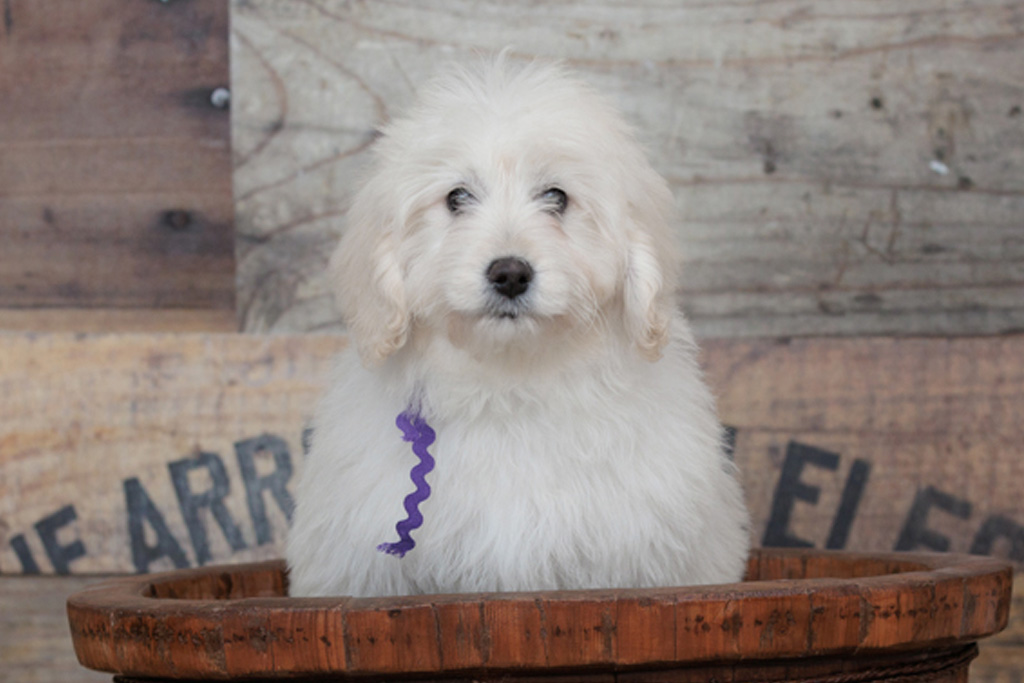
“Low-shedding” is one of those phrases that sounds wonderfully simple until you start asking what it actually means.
For many families considering a Minidoodle, the appeal is obvious. Less loose hair around the house can mean fewer tumbleweeds drifting across the floor, less fur clinging to clothing, and a coat that feels easier to live with day-to-day.
But low-shedding doesn’t mean no shedding, and it definitely doesn’t mean no grooming.
That distinction matters because Minidoodles can inherit a range of coat characteristics from their English Cream Golden Retriever and Toy Poodle parentage. Some coats may shed less visible hair than others, while curlier or denser coats can hold loose hair within the coat rather than dropping it onto the floor.
In practical terms, a dog that sheds less visibly may actually need more regular brushing to remove that loose hair before it contributes to tangles or matting.
So when we talk about a Minidoodle being low-shedding, the most useful way to think about it is not as a guarantee. It is a description of how the coat may behave, and that behavior can vary from one dog to another.
Low-Shedding Does Not Mean Non-Shedding
The first thing to understand is that “low-shedding” is relative.
Some Minidoodles may leave very little noticeable hair around the home, while others may release more, particularly if they inherit a looser or more Golden-like coat.
Doodle coats can vary considerably, and veterinary guidance on Goldendoodles reflects that same reality. Coat texture and shedding are not perfectly predictable simply because a dog has Poodle ancestry.
A curlier Minidoodle may appear to shed very little because much of the loose hair remains caught in the surrounding coat. A looser, wavier coat may release more visible hair.
Neither coat is “better.”
They simply behave differently and require slightly different care.
That is why families are better served by learning their individual Minidoodle’s coat rather than relying on a blanket label.
Where Does the Loose Hair Go?
This is one of the most important things to understand about low-shedding coats.
Hair that does not end up on the couch has not necessarily disappeared.
In curlier or denser coats, loose hair can remain trapped among the surrounding strands. That is part of the reason regular brushing matters so much for many doodle-type coats.
If that loose hair stays in place long enough, it can combine with friction, moisture, and everyday movement to contribute to tangles and mats.
This creates one of the funny tradeoffs of a low-shedding coat: you may spend less time vacuuming visible fur, but you may spend more time maintaining the coat itself.
That is not necessarily a downside. It is simply part of understanding what you are getting.
For many families, that tradeoff is well worth it.
Curlier Coats Often Shed Less Visibly
In general, curlier coats tend to hold onto loose hair more effectively than straighter or looser coats.
That can translate into less visible shedding around the house, which is one reason Poodle-influenced coats are often appealing to families who prefer less loose hair on furniture and clothing.
However, the same curl that helps hold loose hair in the coat can also make tangles develop more easily.
Please note that Minidoodles can vary widely in coat texture and that regular brushing is important to prevent matting, especially in curlier coats.
This is why it is important not to equate “low-shedding” with “low-maintenance.”
In many cases, those are two completely different things.
Wavier Coats May Release More Hair
A Minidoodle with a looser or wavier coat may release more visible hair than a curlier dog.
That does not automatically mean the dog will shed heavily.
It simply means loose hairs may be more likely to fall away naturally rather than remaining trapped in the coat.
Some families actually find these coats easier to maintain because they may tangle less aggressively, depending on the individual texture and length.
Again, there is a tradeoff.
A coat that releases a little more hair around the home may sometimes require less intensive detangling than one that holds nearly every loose hair inside the coat.
The best routine depends on the coat your Minidoodle actually develops.
Puppy Coat Can Give You an Incomplete Picture
A Minidoodle puppy’s first coat is not always a perfect preview of the adult coat.
Puppy coats tend to be softer and can change in texture, density, and curl as the dog matures.
That means shedding patterns can change too.
A puppy that seems exceptionally easy to brush may eventually develop an adult coat that tangles more easily. Another may retain a relatively loose wave and continue releasing more visible hair.
This is one reason it is useful to watch how the coat changes rather than assuming the grooming routine you established at four months will remain exactly the same forever.
We go into that in more detail in “What Your Minidoodle’s Coat Can Tell You About Grooming Needs,” which examines how texture, density, tangling, moisture, and lifestyle can help you understand your individual dog’s needs.
The important point here is that coat behavior evolves.
Low-Shedding Is Not the Same as Hypoallergenic
This is where expectations need to stay especially realistic.
No dog is completely hypoallergenic.
People with dog allergies typically react to proteins found in dander, saliva, and other biological material, not simply to the visible hair itself. VCA notes that all dogs produce allergens in saliva and dander, while AKC similarly emphasizes that no breed or mixed breed is truly 100% hypoallergenic.
Less shedding may reduce the amount of allergen-carrying hair distributed around a home, but it does not eliminate the allergens themselves.
This is an important distinction for families with significant allergies.
A Minidoodle may work very well for some allergy-sensitive households, while another person may still react strongly.
There is no responsible way to guarantee otherwise.
Allergy-Sensitive Families Should Test Their Own Response
If allergies are a major consideration, it is better to gather real information than rely on the word “hypoallergenic.”
Spend time around the dogs when possible and pay attention to how the allergy-sensitive person responds.
For families with more significant or medically important allergies, speaking with an allergist or other medical provider is also a sensible step before making a decision.
The goal is not to discourage anyone from bringing home a Minidoodle.
It is to ensure the decision is based on realistic expectations rather than on a marketing term that sounds more definitive than the science supports.
Research by allergy specialists has found no consistent evidence that hypoallergenic-labeled dogs universally produce lower allergen levels.
Individual response matters.
Less Visible Hair Can Still Mean More Brushing
This is probably the biggest surprise for first-time doodle owners.
You may look around the house and see almost no hair on the floor, which feels like a grooming victory.
Meanwhile, the loose hair is still sitting inside the coat.
Regular brushing removes trapped hair before it begins to tangle with the surrounding coat.
For many Minidoodles, especially those with longer or curlier coats, brushing several times a week may be necessary, with some coats needing even more frequent attention.
Professional grooming remains important too.
A low-shedding coat still grows, tangles, collects debris, and changes over time.
If you want a deeper look at professional appointment timing, How Often Should a Minidoodle Really Be Professionally Groomed? walks through the usual six-to-eight-week starting point and explains how coat type, age, haircut, and lifestyle can shorten or extend that schedule.
Low shedding does not replace grooming.
It changes the kind of grooming you need to do.
The Coat Length Makes a Difference
Longer coats have more opportunity to tangle, regardless of how much visible shedding you see.
A Minidoodle with a fuller, longer style may need more brushing simply because there is more coat moving, rubbing, and trapping loose hair.
Shorter trims usually make maintenance easier.
This is especially true for active families whose Minidoodles spend plenty of time outdoors, swim regularly, or wear harnesses that create friction against their coats.
There is no requirement that a Minidoodle maintain a long, fluffy style.
The best haircut is one that suits the coat, the dog’s lifestyle, and the amount of home grooming the family realistically wants to maintain.
Your Vacuum Cleaner Is Not a Scientific Instrument
It can be tempting to judge your Minidoodle’s shedding entirely by what you see on the floor.
That only tells part of the story.
A low-shedding dog may still be losing hair naturally, but the coat’s structure keeps much of it trapped until brushing removes it.
This is why two Minidoodles can create very different experiences inside the home even if neither would be described as a heavy shedder.
One family may notice occasional hair on clothing. Another may see very little loose hair but spend more time working through a dense coat with a brush and comb.
Both experiences fall under the broad idea of low shedding.
Seasonal Changes Can Still Happen
Dogs are not static, and coats can behave differently throughout the year.
Changes in daylight, environment, coat growth, grooming length, and activity can all affect how much loose hair you notice and how much maintenance the coat requires.
A Minidoodle who spends much of summer swimming may need more coat attention because of moisture and tangling. Winter clothing and harnesses can create friction in different areas.
The practical lesson is not to expect one grooming routine to work perfectly forever.
Pay attention to the coat in front of you and adjust when needed.
Regular Grooming Helps Keep Loose Hair Under Control
Professional grooming and home care work together especially well for low-shedding coats.
Brushing removes loose hair and prevents it from building up in the coat. Bathing can help remove additional loose material, while trimming keeps the length manageable.
PetMD recommends regular brushing for Goldendoodle coats specifically to reduce tangles and matting.
This is why scheduled professional grooming is useful even when your Minidoodle never seems to leave hair around the house.
The groomer is not just cutting hair.
They are helping reset and maintain a coat that continues growing and holding onto loose material between appointments.
Coat Care Is the Tradeoff, Not the Catch
It is easy to describe low-shedding coats as though there must be some hidden downside.
That is not really the right way to think about it.
Every coat comes with maintenance.
A heavier-shedding dog may require more vacuuming and loose-hair cleanup. A low-shedding Minidoodle may require more brushing and professional grooming to remove hair that remains within the coat.
Neither experience is inherently better or worse.
Families simply need to know which kind of maintenance they are signing up for.
For many Minidoodle owners, having less visible hair around the home is a major benefit, and regular grooming quickly becomes part of the normal routine.
One Minidoodle May Shed Differently From Another
Mixed-breed genetics introduce variation.
Because Royal Minidoodles have English Cream Golden Retriever and Toy Poodle parentage, puppies can inherit different combinations of coat traits.
That means families should avoid expecting every Minidoodle to shed exactly the same amount simply because they share the same cross.
Some may have curlier coats that release very little visible hair.
Others may have a softer wave and shed somewhat more.
The exact adult coat can also become clearer as the puppy matures.
This variability is normal and is one reason thoughtful expectations matter so much.
Focus on the Dog, Not the Label
“Low-shedding” can be a useful description, but it should not become the only thing you know about the coat.
Pay attention to your actual dog.
Does the coat release much visible hair? Does it tangle quickly? How easily can you comb through it? Does moisture stay trapped after swimming? How long do you prefer to keep the coat?
Those observations will tell you far more about your Minidoodle’s care needs than any single label.
If you want help interpreting those clues, our guide to What Your Minidoodle’s Coat Can Tell You About Grooming Needs is the natural next step.
From there, How Often Should a Minidoodle Really Be Professionally Groomed? can help you translate the coat’s needs into an appointment schedule that works for your dog and your household.
Together, those three pieces give you a much more useful picture than simply asking whether Minidoodles shed.
What “Low-Shedding” Really Means in Daily Life
For many families, low-shedding means exactly what they hoped it would mean: noticeably less loose hair around the house.
That can be a wonderful benefit.
It simply comes with a little context.
Your Minidoodle may still shed some hair. The adult coat may behave differently from the puppy coat. Curlier coats can hold loose hair rather than drop it, which makes brushing especially important. And less-visible shedding does not guarantee a dog is allergy-friendly.
Once you understand those tradeoffs, the phrase becomes much more useful.
Low-shedding does not mean maintenance-free.
It means the maintenance often happens with a brush and groomer rather than entirely on your floors and furniture.
For many Royal Minidoodle families, that is a trade they are more than happy to make.
Frequently Asked Questions
Do Minidoodles shed?
Yes, Minidoodles can shed, but many shed relatively little compared with heavier-shedding dogs. The amount varies depending on the individual coat and the traits inherited from the English Cream Golden Retriever and Miniature Poodle parents.
Are Minidoodles non-shedding?
It is better to describe them as potentially low-shedding rather than completely non-shedding. Individual Minidoodles can vary in how much visible hair they release.
Are Minidoodles hypoallergenic?
No dog can be guaranteed hypoallergenic. Dog allergies are usually triggered by proteins associated with dander and saliva, which all dogs produce.
Does a curlier Minidoodle shed less?
Curlier coats often release less visible hair because loose hairs remain caught within the coat. That can mean less hair around the home, but a greater need for regular brushing to prevent tangles.
Do wavy Minidoodles shed?
They can. Looser or wavier coats may release more visible hair than curlier coats, although the amount still varies by individual dog.
Can a Minidoodle’s shedding change as they grow?
Yes. The adult coat may differ from the puppy coat in texture, density, curl, and shedding behavior, so grooming needs can change as the dog matures.
Does low-shedding mean less grooming?
Not necessarily. Low-shedding coats may require frequent brushing because loose hair can become trapped in the coat rather than falling out naturally.
How often should a low-shedding Minidoodle be brushed?
It depends on coat length, curl, and density. Many need brushing several times per week, while longer or curlier coats may require more frequent attention.
How often should a Minidoodle be professionally groomed?
Many Minidoodles do well with professional grooming every 6 to 8 weeks, although coat type, length, lifestyle, and home maintenance can alter that schedule.
Can someone with dog allergies safely own a Minidoodle?
Possibly, but there is no guarantee. Individual reactions vary, and families with significant allergies should spend time around dogs when possible and speak with their medical provider before relying on a low-shedding label.